September 18 Patron: of Bohemia Birth: 860 Death: 921
St. Ludmila was the daughter of a Slavic prince, she married Duke Borivoy of Bohemia, whom she followed into the Church. They built a church near Pragueand tried unsuccessfully to force Christianity on their subjects. On the death of Borivoy, his sons Spytihinev and Ratislav, who had married Drahomira, succeeded him, and Ludmila brought up the latters son Venceslaus. On the death of Ratislav, Drahomira became regent, kept Wenceslaus from Ludmila and reportedly caused her to be strangled at Tetin. Her Feastday is September 16th.
Not to be confused with Ludmilla of Bohemia.
"Saint Ludmila" redirects here. For the oratorio by Dvořák, see Saint Ludmila (oratorio).
Saint Ludmila (c. 860 – 15 September 921) is a Czech saint and martyrvenerated by the Orthodox and the Roman Catholics. She was born in Mělník[1] as the daughter of the Sorbianprince Slavibor.[2] Saint Ludmila was the grandmother of Saint Wenceslaus,[1] who is widely referred to as Good King Wenceslaus. Saint Ludmila was canonized shortly after her death. As part of the process of canonization, in 925, Wenceslaus moved her remains to the St. George's Basilica, Prague.
Contents
1Marriage
2Ludmila and Drahomíra
3See also
4References
5Sources
Marriage
Ludmila was married to Bořivoj I of Bohemia, the first Christian Duke of Bohemia,[1] in 873. The couple was converted to Christianity through the efforts of Saint Methodius.[1][3] Their efforts to convert Bohemia to Christianity were initially not well received,[1] and they were driven from their country for a time by the pagans. Eventually the couple returned, and ruled for several years before retiring to Tetín, near Beroun.
The couple was succeeded by their son Spytihněv. Spytihněv was succeeded by his brother Vratislav. When Vratislav died in 921, his son Wenceslas became the next ruler of Bohemia.[3] It had been mainly Ludmila who raised her grandson and she now acted as regent for him.
Ludmila and Drahomíra
Murder of Saint Ludmila
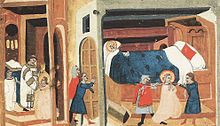
Wenceslaus' mother Drahomíra became jealous of Ludmila's influence over Wenceslaus. She had two noblemen Tunna and Gommon (probably of Frankish or Varangian descend) murder Ludmila at Tetín, and part of Ludmila's story says that she was strangled[1] with her veil. Initially, Saint Ludmila was buried at St. Michael's at Tetín.[4]
Saint Ludmila was canonized shortly after her death. As part of the process of canonization, in 925, Wenceslaus moved her remains to the St. George's Basilica, Prague.[3] She is venerated as a patroness of Bohemia. She is considered to be a patron saint of Bohemia, converts, Czech Republic, duchesses, problems with in-laws, and widows. Her feast day is celebrated on September 16th.
Antonín Dvořák composed his oratorio Svatá Ludmila (Saint Ludmila) between September 1885 and May 1886. The work was commissioned by the publisher Littleton for the Leeds Festival.[5]
September 18 Death: 1936 Beatified: 1 October 1995 by Pope John Paul II
Jesus Hita Miranda was a member of the Marianistsand was martyred along with Blessed Carlo Erana Guruceta and Blessed Fidel Fuidio Rodriguez during the Spanish Civil War.
A tribune in the Roman imperial army at Vienne, France. He sheltered St. Julian of Brioude and was arrested by the local governor, Crispin. Scourged and imprisoned, Gerreoulus escaped miraculously but was recaptured and beheaded.
September 18 Death: 1842 Canonized: Pope John Paul II
Vietnamese martyr and a priest member of the Dominican Third Order. Caught up in the persecution against Christians, Dominic was beheaded. He was canonized in 1988.
The Vietnamese Martyrs (Vietnamese: Các Thánh Tử đạo Việt Nam), also known as the Martyrs of Annam, Martyrs of Tonkin and Cochinchina, Martyrs of Indochina, or Andrew Dung-Lac and Companions (Anrê Dũng-Lạc và các bạn tử đạo), are saints on the General Roman Calendar who were canonized by Pope John Paul II. On June 19, 1988, thousands of overseas Vietnamese worldwide gathered at the Vatican for the Celebration of the Canonization of 117 Vietnamese Martyrs, an event chaired by Monsignor Tran Van Hoai. Their memorial is on November 24 (although several of these saints have another memorial, as they were beatified and on the calendar prior to the canonization of the group).
Contents
1History
2The Nguyen Campaign against Catholicism in the 19th century
3List of Vietnamese Martyrs
4The causes are being promoted
5See also
6Notes
7References
8External links
History
The Vatican estimates the number of Vietnamese martyrs at between 130,000 and 300,000. John Paul II decided to canonize those whose names are known and unknown, giving them a single feast day.
The Vietnamese Martyrs fall into several groupings, those of the Dominican and Jesuit missionary era of the 18th century and those killed in the politically inspired persecutions of the 19th century. A representative sample of only 117 martyrs—including 96 Vietnamese, 11 Spanish Dominicans, and 10 French members of the Paris Foreign Missions Society (Missions Etrangères de Paris (MEP))—were beatified on four separate occasions: 64 by Pope Leo XIII on May 27, 1900; eight by Pope Pius X on May 20, 1906; 20 by Pope Pius X on May 2, 1909; and 25 by Pope Pius XII on April 29, 1951.[citation needed] All these 117 Vietnamese Martyrs were canonized on June 19, 1988. A young Vietnamese Martyr, Andrew Phú Yên, was beatified in March, 2000 by Pope John Paul II.
Vietnamese martyrs Paul Mi, Pierre Duong, Pierre Truat, martyred on 18 December 1838.
The tortures these individuals underwent are considered by the Vatican to be among the worst in the history of Christian martyrdom. The torturers hacked off limbs joint by joint, tore flesh with red hot tongs, and used drugs to enslave the minds of the victims. Christians at the time were branded on the face with the words "tà đạo" (邪道, lit. "Left (Sinister) religion")[1] and families and villages which subscribed to Christianity were obliterated.[2]
The letters and example of Théophane Vénard inspired the young Saint Thérèse of Lisieux to volunteer for the Carmelitenunnery at Hanoi, though she ultimately contracted tuberculosis and could not go. In 1865 Vénard's body was transferred to his Congregation's church in Paris, but his head remains in Vietnam.[3]
There are several Catholic parishes in the United States, Canada, and elsewhere dedicated to the Martyrs of Vietnam (Holy Martyrs of Vietnam Parishes), one of which is located in Arlington, Texas in the Dallas-Fort Worth area.[4] Others can be found in Houston, Austin, Texas,[5]Denver, Seattle, San Antonio,[6] Arlington, Virginia, Richmond, Virginia, and Norcross, Georgia. There are also churches named after individual saints, such as St. Philippe Minh Church in Saint Boniface, Manitoba.[7]
The Nguyen Campaign against Catholicism in the 19th century
The Catholic Church in Vietnam was devastated during the Tây Sơn rebellionin the late 18th century. During the turmoil, the missions revived, however, as a result of cooperation between the French Vicar Apostolic Pigneaux de Behaine and Nguyen Anh. After Nguyen's victory in 1802, in gratitude to assistance received, he ensured protection to missionary activities. However, only a few years into the new emperor's reign, there was growing antipathy among officials against Catholicism and missionaries reported that it was purely for political reasons that their presence was tolerated.[8] Tolerance continued until the death of the emperor and the new emperor Minh Mang succeeding to the throne in 1820.
Converts began to be harassed without official edicts in the late 1820s, by local governments. In 1831 the emperor passed new laws on regulations for religious groupings in Viet Nam, and Catholicism was then officially prohibited. In 1832, the first act occurred in a largely Catholic village near Hue, with the entire community being incarcerated and sent into exile in Cambodia. In January 1833 a new kingdom-wide edict was passed calling on Vietnamese subjects to reject the religion of Jesus and required suspected Catholics to demonstrate their renunciation by walking on a wooden cross. Actual violence against Catholics, however, did not occur until the Lê Văn Khôi revolt.[8]
During the rebellion, a young French missionary priest named Joseph Marchand was living in sickness in the rebel Gia Dinh citadel. In October 1833, an officer of the emperor reported to the court that a foreign Christian religious leader was present in the citadel. This news was used to justify the edicts against Catholicism, and led to the first executions of missionaries in over 40 years. The first executed was named Francois Gagelin. Marchand was captured and executed as a "rebel leader" in 1835; he was put to death by "slicing".[8] Further repressive measures were introduced in the wake of this episode in 1836. Prior to 1836, village heads had only to simply report to local mandarins about how their subjects had recanted Catholicism; after 1836, officials could visit villages and force all the villagers to line up one by one to trample on a cross and if a community was suspected of harbouring a missionary, militia could block off the village gates and perform a rigorous search; if a missionary was found, collective punishment could be meted out to the entire community.[8]
Missionaries and Catholic communities were able to sometimes escape this through bribery of officials; they were also sometimes victims of extortion attempts by people who demanded money under the threat that they would report the villages and missionaries to the authorities.[8] The missionary Father Pierre Duclos said:
with gold bars murder and theft blossom among honest people.[8]
The court became more aware of the problem of the failure to enforce the laws and applied greater pressure on its officials to act; officials that failed to act or those tho who were seen to be acting too slowly were demoted or removed from office (and sometimes were given severe corporal punishment), while those who attacked and killed the Christians could receive promotion or other rewards. Lower officials or younger family members of officials were sometimes tasked with secretly going through villages to report on hidden missionaries or Catholics that had not apostasized.[8]
The first missionary arrested during this (and later executed) was the priest Jean-Charles Cornay in 1837. A military campaign was conducted in Nam Dinh after letters were discovered in a shipwrecked vessel bound for Macao. Quang Tri and Quang Binh officials captured several priests along with the French missionary Bishop Pierre Dumoulin-Borie in 1838 (who was executed). The court translator, Francois Jaccard, a Catholic who had been kept as a prisoner for years and was extremely valuable to the court, was executed in late 1838; the official who was tasked with this execution, however, was almost immediately dismissed.[8]
A priest, Father Ignatius Delgado, was captured in the village of Can Lao (Nam Định Province), put in a cage on public display for ridicule and abuse, and died of hunger and exposure while waiting for execution; [1] the officer and soldiers that captured him were greatly rewarded (about 3 kg of silver was distributed out to all of them), as were the villagers that had helped to turn him over to the authorities.[8] The bishop Dominic Henares was found in Giao Thuy district of Nam Dinh (later executed); the villagers and soldiers that participated in his arrest were also greatly rewarded (about 3 kg of silver distributed). The priest, Father Joseph Fernandez, and a local priest, Nguyen Ba Tuan, were captured in Kim Song, Nam Dinh; the provincial officials were promoted, the peasants who turned them over were given about 3 kg of silver and other rewards were distributed. In July 1838, a demoted governor attempting to win back his place did so successfully by capturing the priest Father Dang Dinh Vien in Yen Dung, Bac Ninh province. (Vien was executed). In 1839, the same official captured two more priests: Father Dinh Viet Du and Father Nguyen Van Xuyen (also both executed).[8]
In Nhu Ly near Hue, an elderly catholic doctor named Simon Hoa was captured and executed. He had been sheltering a missionary named Charles Delamotte, whom the villagers had pleaded with him to send away. The village was also supposed to erect a shrine for the state-cult, which the doctor also opposed. His status and age protected him from being arrested until 1840, when he was put on trial and the judge pleaded (due to his status in Vietnamese society as both an elder and a doctor) with him to publicly recant; when he refused he was publicly executed.[8]
A peculiar episode occurred in late 1839, when a village in Quang Ngai province called Phuoc Lam was victimized by four men who extorted cash from the villagers under threat of reporting the Christian presence to the authorities. The governor of the province had a Catholic nephew who told him about what happened, and the governor then found the four men (caught smoking opium) and had two executed as well as two exiled. When a Catholic lay leader then came to the governor to offer their gratitude (thus perhaps exposing what the governor had done), the governor told him that those who had come to die for their religion should now prepare themselves and leave something for their wives and children; when news of the whole episode came out, the governor was removed from office for incompetence.[8]
Many officials preferred to avoid execution because of the threat to social order and harmony it represented, and resorted to use of threats or torture in order to force Catholics to recant. Many villagers were executed alongside priests according to mission reports. The emperor died in 1841, and this offered respite for Catholics. However, some persecution still continued after the new emperor took office. Catholic villages were forced to build shrines to the state cult. The missionary Father Pierre Duclos (quoted above) died in prison in after being captured on the Saigon river in June 1846. The boat he was traveling in, unfortunately contained the money that was set for the annual bribes of various officials (up to 1/3 of the annual donated French mission budget for Cochinchina was officially allocated to 'special needs') in order to prevent more arrests and persecutions of the converts; therefore, after his arrest, the officials then began wide searches and cracked down on the catholic communities in their jurisdictions. The amount of money that the French mission societies were able to raise, made the missionaries a lucrative target for officials that wanted cash, which could even surpass what the imperial court was offering in rewards. This created a cycle of extortion and bribery which lasted for years.[8]
List of Vietnamese Martyrs
Those whose names are known are listed below:
Please keep in mind that these are the anglicized versions of their names
Andrew Dung-Lac An Tran
Augustin Schoeffler, MEP, a priestfrom France
Agnes Le Thi Thanh
Bernard Vũ Văn Duệ
Emmanuel Le Van Phung
Emmanuel Trieu Van Nguyen
Francis Chieu Van Do
Francis Gil de Frederich|Francesc (Francis) Gil de Federich, OP, a priest from Catalonia (Spain)
François-Isidore Gagelin, MEP, a priest from France
Francis Jaccard, MEP, a priest from France
Francis Trung Von Tran
Francis Nguyen
Ignatius Delgado y Cebrian, OP, a bishop from Spain
Jacinto (Hyacinth) Casteñeda, OP, a priest from Spain
James Nam
Jerome Hermosilla, OP, a bishop from Spain
John Baptist Con
John Charles Cornay, MEP, a priest from France
John Dat
John Hoan Trinh Doan
John Louis Bonnard, MEP, a priest from France
John Thanh Van Dinh
José María Díaz Sanjurjo, OP, a bishop from Spain
Joseph Canh Luang Hoang
Joseph Fernandez, OP, a priest from Spain
Joseph Hien Quang Do
Joseph Khang Duy Nguyen
Joseph Luu Van Nguyen
Joseph Marchand, MEP, a priest from France
Joseph Nghi Kim
Joseph Thi Dang Le
Joseph Uyen Dinh Nguyen
Joseph Vien Dinh Dang
Joseph Khang, a local doctor
Joseph Tuc
Joseph Tuan Van Tran
Lawrence Ngon
Lawrence Huong Van Nguyen
Luke Loan Ba Vu
Luke Thin Viet Pham
Martin Tho
Martin Tinh Duc Ta
Matthew Alonzo Leziniana, OP, a priest from Spain
Matthew Phuong Van Nguyen
Matthew Gam Van Le
Melchor García Sampedro, OP, a bishop from Spain
Michael Dinh-Hy Ho
Michael My Huy Nguyen
Nicholas Thé Duc Bui
Paul Hanh
Paul Khoan Khan Pham
Paul Loc Van Le
Paul Tinh Bao Le
Paul Tong Viet Buong
Paul Duong
Pere (Peter) Almató i Ribera, OP, a priest from Catalonia (Spain)
Peter Tuan
Peter Dung Van Dinh
Peter Da
Peter Duong Van Truong
Peter Francis Néron, MEP, a priest from France
Peter Hieu Van Nguyen
Peter Quy Cong Doan
Peter Thi Van Truong Pham
Peter Tuan Ba Nguyen, a fisherman
Peter Tuy Le
Peter Van Van Doan
Philip Minh Van Doan
Pierre Borie, MEP, a bishop from France
Simon Hoa Dac Phan
Stephen Theodore Cuenot, MEP, a bishop from France
Stephen Vinh
Théophane Vénard, MEP, a priest from France
Thomas De Van Nguyen
Thomas Du Viet Dinh
Thomas Thien Tran
Thomas Toan
Thomas Khuong
Valentine Berriochoa, OP, a bishop from the Basque Country
September 18 Birth: 1884 Death: 1936 Beatified: 1 October 1995 by Pope John Paul II
Carlo Erana Guruceta was a member of the Marianists. Martyred with Blessed Fidel Fuidio Rodriguez and Blessed Jesus Hita Miranda during the Spanish Civil War.
A group of martyrs who were put to death at an unknown date at Noviodonum, in Lower Moesia on the Danube, although the site of their martyrdom may have been in Rhaetia, modern Switzerland.
Bishop and missionary, also called Huno and Unno. Originally a Benedictine monkat New Corvey. in Saxony. Germany, he received appointment in 917 to the post of bishop of Bremen-Hamburg. As bishop. he strove to evangelize Denmarkand Sweden, enjoying considerable success in his efforts.
Roman martyr. A wealthy woman of noble birth, she contributed freely of her fortune to ease the suffering of the Christians during the persecutions of Emperor Diocletian (r. 284-305). She died, perhaps by martyrdom, while the persecutions were still ongoing.
Feastday: September 17 Patron: of the sacristans of the Archdiocese of Milano Death: 376
Confessor and brother of Sts. Ambrose and Marcellina. Born at Trier, Germany, he moved to Rome with his family and was subsequently trained as a lawyer. Appointed prefect to one of the Roman provinces, he resigned his post when Ambrose became archbishop of Milan in order to assume administration of the secular affairs of the archdiocese. He died unexpectedly at Milan and was eulogized by his brother with the funeral sermon, "On the death of a brother."
Saint Satyrus of Milan (Italian: San Satiro) was the confessor and brother of Saints Ambrose and Marcellina. He was born around 331 at Trier, Germany, moved to Rome with his family and was subsequently trained as a lawyer.
Appointed prefect to one of the Roman provinces, he resigned his post when Ambrose became Archbishop of Milan in order to assume administration of the secular affairs of the archdiocese.
He died unexpectedly at Milan in 378 and was eulogised by his brother with the funeral sermon, On the Death of a Brother (De excessu fratris Satyri). The church of Santa Maria presso San Satiroin Milan refers to him.[1]
He should not be confused with the bishop Satyrus of Arezzo.
Benedictine abbot, also listed as Rouin and Radingus. Originally from Ireland, he went to Germany and found much success preaching and converting the local pagans. After spending time in the monastery of Tholey, near Trier, Germany, he pursued a hermit's life in the Argonne forest, France, where he soon attracted followers and founded the community which was later called Beaulieu.
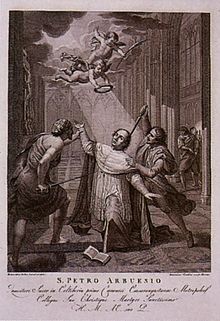
Augustinian inquisitor. He was born in Aragon, Spain, and became a master of CanonLaw at the University of Bolognabefore becoming an Augustinian canonat Saragossa in 1478. In 1484 he received appointment as Inquisitor of Aragon and soon earned the enmity of the Marranos, Jews who had been forcibly converted to Catholicism. Peter was murdered by a group of Marranos in the cathedral of Saragossa. His name has been associated with acts of wanton cruelty and inhumanity in the fulfillment of his office as Inquisitor, although these have never been substantiated.
Pedro de Arbués (c. 1441 – 17 September 1485) was a Spanish Roman Catholic priest and a professed Augustinian canon.[2] He served as an official of the Spanish Inquisition until he was assassinated in the La Seo Cathedral in Zaragoza in 1485 allegedly by Jews and conversos.[3] The veneration of him came swiftly through popular acclaim. His death greatly assisted the Inquisitor-General Tomás de Torquemada's campaign against hereticsand crypto-Jews.
His canonization was celebrated on 29 June 1867.[4]
Contents
1Life
2Sainthood
3See also
4Notes and references
5Further reading
6External links
Life
Pedro de Arbués was born at Épila in the region of Zaragoza to the noblemanAntonio de Arbués and Sancia Ruiz.[4]
He studied philosophy perhaps in Huesca but later travelled to Bologna on a scholarship to the Spanish College of Saint Clement which was part of the Bologna college. He obtained his doctorate in 1473 while he served as a professor of moral philosophical studies or ethics.[3] Upon his return to Spain he became a member of the cathedral chapter of the canons regular at La Seo where he made his religious professionin 1474.[2][4]
At around that time Ferdinand and Isabella had obtained from Pope Sixtus IV a papal bull to establish in their kingdom a tribunal for searching out heretics. Those Jews who had received baptism were known as conversos; some might have continued to practice Judaism in secret.[3][4] Tomás de Torquemada was in 1483 appointed as the Grand Inquisitor for Castile. He then appointed Arbués and Pedro Gaspar Juglar as Inquisitors Provincial in the Kingdom of Aragon on 4 May 1484. Their work was opposed by converts and people who saw it as a threat to their freedoms.[3][2]
On 14 September 1485 Pedro was attacked in the cathedral as he knelt before the altar and had been wearing armour since he knew his work posed great risks.[3] Despite wearing a helmet and chain mail he died from his wounds on 17 September. His remains were entombed in a special chapel dedicated to him.[2]
The Inquisition was opposed in Aragonas it was seen as an imperial attack on the charters, privileges and local laws. The most powerful families among the converted Jews: the Sánchez, Montesa, Paterno and Santangel families seem to have been involved in the murder.[4]
As a result, a popular movement against the Jews arose in which nine were executed, two killed themselves, thirteen were burnt in effigy, and four punished for complicity, from 30 June to 15 December 1486, according to the historian Jerónimo Zurita. Leonardo Sciascia in Morte dell'inquisitore (1964) writes that Arbués along with Juan Lopez Cisneros (d. 1657) are "the only two cases of inquisitors who died assassinated".[4][5]
Sainthood
Pope Alexander VII beatified the late priest in Rome on 20 April 1664.
His canonization was celebrated on 29 June 1867 among protests from Jews and Christians. Pope Pius IX said in the document formalizing the canonization (Maiorem caritatem): "The divine wisdom has arranged that in these sad days, when Jews help the enemies of the church with their books and money, this decree of sanctity has been brought to fulfillment