St. Candidus
Feastday: October 3
Death: unknown
A Roman martyr buried on the Esquiline Hill.

St. Candidus
Feastday: October 3
Death: unknown
A Roman martyr buried on the Esquiline Hill.
Bl. Columba Marmion
Feastday: October 3
Birth: 1858
Death: 1923
Beatified: September 3, 2000, by Pope John Paul II

Blessed Columba Marmion, born Joseph Aloysius Marmion (April 1, 1858 - January 30, 1923) was an Irish monk, and the third abbot of Maredsous Abbey. Beatified by Pope John Paul II on September 3, 2000, Marmion was one of the most popular and influential Catholic writers of the 20th century. His books are considered spiritual classics.
Columba Marmion, OSB, born Joseph Aloysius Marmion (April 1, 1858 – January 30, 1923) was a Roman Catholic Benedictine Irish monk and the third Abbot of Maredsous Abbey in Belgium. Beatified by Pope John Paul II on September 3, 2000, Columba was one of the most popular[1] and influential[2] Catholic authors of the 20th Century. His books are considered spiritual classics.[3]
Young Marmion
Columba was born in Queen Street, Dublin, Ireland on April 1, 1858, into a large and very religious family; three of his sisters became nuns. His father, William Marmion was from Clane, Co. Kildare. His mother, Herminie Cordier was French, prompting his biographer, Dom Raymond Thibaut to remark: "He owes to his Celtic origin his penetrating intelligence, his lively imagination, his sensibility, his exuberance and his youthful spirit. The French blood which ran in his veins contributes to his clearness of mind, his habit of clear perception, his ease of exposition, and his uprightness of character. From the combination of the two he derives his constant gaiety and his generosity of heart with all the strength, devotion, and fine feeling which this noble quality implies."[4] He was baptised with the name "Joseph Aloysius". From a very early age he was seemingly "consumed with some kind of inner fire or enthusiasm for the things of God."[5] He was educated at the Jesuit Belvedere College in Dublin.
He entered the seminary at the age of 16.[6] At the time he entered the seminary, his "faith[7] was very strong";[8] he perceived "something more than simple theoretical theses"[8] in Catholic doctrine, in particular "that a man's love for God is measured by his love for his neighbor."[9]
One day during a vacation [at about the age of 17] he learnt that a poor old woman, well known to his family, was threatened with being summoned before the magistrates by an exacting creditor who claimed the payment of a somewhat large debt. The young seminarian possessed an equivalent amount saved up little by little for a trip he had promised himself. A struggle went on in his heart between his generosity and the legitimate desire to enjoy the fruit of his economies. This struggled lasted all night. In the morning charity had gained the day; with his father's consent he generously made over his savings in favor of the poor woman.[9]
A "very important moment in Dom Marmion's inner life"[10] occurred while he was still in seminary.
It seems that one day when returning to the study hall he had all at once, to use his own words, "a light on God's Infinity." While this "light" only lasted for an instant, it was so clear and strong that it left an indelible impression on him, so that... "he referred to this not without emotion and thanksgiving during the last days of his life."[11]
1881
He completed his studies in Rome at the Pontifical Irish College and was ordained in 1881.[12]
On his journey back to Ireland, he passed through Maredsous, Belgium – a young and dynamic monastery founded 9 years before (in 1872) by Benedictine monks from the Abbey of Beuron, Germany.[13] He wished very much to join the community there.[14] But his archbishop in Ireland refused his request to do so and appointed him as curate at Dundrum,[15] a parish in the south of Dublin. After a year, he was appointed Professor of Metaphysics at Holy Cross College at Clonliffe, the diocesan seminary for Dublin where Marmion himself had studied.[16] For the next four years (1882–1886) he embarked on the education and spiritual direction of others, including his appointment as chaplain to a nearby convent.[17]
Parish priest
Marmion's work as a parish priest "daily brought him into contact with a cross-section of humanity," and he was "called upon to advise, teach, console and give every kind of spiritual and material aid."[18] He "possessed an extraordinary facility for adapting himself to other people," and above all "in comforting others and putting them at their ease."[18] During this period he began to learn "the delicate art of spiritual direction in which he was later to excel."[19]
His four years as professor at Clonliffe (1882–1886) "helped to complete his intellectual and spiritual formation. Thrown into the atmosphere of college life, he soon found himself in his native element."[20]
Maredsous (1886–1899)
Maredsous Abbey
Marmion joined the monastic community at Maredsous in 1886, having received his archbishop's approval.[21] At first, it was very hard for him, even "traumatic."[22] He was 27 years old, a respected priest and professor. In Maredsous he was a novice, and had as well to learn a language (French) and monastic disciplines that were foreign to him.
After his Solemn Profession on February 10, 1891, Columba[23] (as he was now called) was appointed to act as assistant to the Novice Master – with whom he got on rather badly[24] – and in addition to preach at parishes in the vicinity of the Abbey.
"There was an element of the dramatic in his initiation into pastoral work. A neighboring parish priest, whose preacher had unexpectedly failed him on the eve of a great feast, came to the Benedictines to ask their help in his difficulty. The superior was very sorry, but he had no one to offer him except a young Irish monk whose French was far from perfect. 'I will take him all the same,' said the parish priest, and he brought off Dom Columba. Three days later he brought him back to the Abbey saying: 'We have never had such a preacher before in my parish.' And soon the other parish priests were competing with each other for 'the Irish father.'"[25]
Monastic formation
The young monk (1888)
During a season of "monastic calm" from 1891 to 1899,[26] Marmion's spiritual life came "to full maturity"[27] as he attended to "the various duties of the monastic state, the life of silence and recollection, of constant fidelity to the liturgy."[26] Of particular importance to him were developing a spirit of obedience,[28] compunction,[29] and humility,[30] as well as continued growth in the fundamental matters of faith,[31] hope,[32] and charity.[33]
Above all, his spiritual life became more and more centered on Christ.
1887: After breakfast, while walking in the garden, I read the eighth chapter of The Imitation of Christ and I felt strongly impelled to take Jesus as my one friend. I realized that, in spite of my great weakness and unfaithfulness, Jesus desired to be my friend above all others. The text: "My delights are to be with the children of men" [Proverbs 8:31], gripped me and compelled me irresistibly to respond with all my heart to this desire of Jesus. In the course of this meditation I felt the near presence of Jesus and a great desire to do all things before His eyes.[34]
1895: We are infinitely rich in Jesus Christ and God's mercies are to our miseries what the ocean is to a drop of water. We never glorify God more than when despite the sight of our sins and unworthiness we are so filled with confidence in His mercy and in the infinite merits of Jesus Christ that we throw ourselves on His bosom full of confidence and love, sure that He cannot repel us: "a humble and contrite heart, Oh God, Thou wilt not despise."[35]
1896: Oh, my dear child, I would wish to engrave on your heart in letters of gold this truth, that no matter how great our misery, we are infinitely rich in Jesus Christ, if we unite with Him, if we lean on Him, if we realize constantly by a firm living faith that all the value of our prayer, and of all that we do comes from His merits in us.[36]
Prior of Mont César, Louvain (1899–1909)
In 1899, Dom Columba helped to found the Abbey of Mont César, Louvain, Belgium, and became its first Prior.[37] He was invested with heavy responsibilities: Director of Studies for the young monks; Professor of Theology; spiritual director of Carmelite nuns, all in addition to being Prior. He gave retreats in Belgium and the United Kingdom. He also became confessor to the future Cardinal Mercier.[38]
Marmion the teacher
Marmion's great gift for teaching came into full bloom during this period. His lectures were distinguished by, "on the one hand, his extreme clearness, and on the other his happy and fluent application of doctrine to the inner life."[39] Rather than presenting "revealed truths like mere theorems of geometry having no bearing on the interior life,"[40] Marmion sought to inspire his students to "live in and by the mysteries he set forth to them."[41]
The fruitful years in Mont César enabled him to attain an unrivalled mastery of his subjects. Others may surpass him in the detailed documentation of their learning; but when Dom Columba discusses one of the major theses in which dogma approaches the highest mysteries of God... his teaching has a breadth which approaches the infinite. The vast repercussions of his thought, the fruit of long contemplation, throw light on a whole world of secondary conclusions. His trenchant summaries unite with an unusual power of synthesis in one beam of light the diverse aspects of a problem hidden at the first approach in its complexity. The central point stands out in brilliant relief and the whole assembly of connected truths is illuminated by the light of a governing principle which is the key to the whole problem. As a master of synthesis he is unrivalled.[42]
Abbot of Maredsous (1909–1923)
Abbot of Maredsous
In 1893, Dom Hildebrand de Hemptinne, Second Abbot of Maredsous, was appointed by Pope Leo XIII as the first Abbot Primate of the Benedictine Order.[43] At the request of the Pope, Dom Hildebrand continued as Abbot of Maredsous, but relinquished that office in 1909.[44]
In that year, at the age of 51, "at the height of his powers, both physical and intellectual,"[45] Dom Marmion was elected Third Abbot of Maredsous. A community consisting of a hundred monks,[46] it ran two schools[47] and was a publisher, in particular of La Revue bénédictine.[48] Marmion adopted as his motto Magis prodesse quam praesse, "To serve rather than be served," a maxim taken from the Rule of St. Benedict.[49] The monastery had great spiritual and intellectual influence under his leadership. Vocations abounded. But Dom Marmion was not indifferent to temporal matters. Thus he had the Abbey equipped with electricity and central heating, facilities rarely to be found in monasteries at that time.[50]
"Gathering up all he had learnt during his priesthood of nearly thirty years and concentrating in his mind the treasures of theological science accumulated during as many years of study and teaching, a consummate master in dogmatics and asceticism, an experienced spiritual director, and a contemplative who constantly searched into the mysteries of God, Dom Marmion was now about to give the matured fruits of these years and to be above all among his own monks, the exponent of the Christian and monastic life in its fullness."[51]
Maredsous and other communities
In 1909, the government of Belgium asked Maredsous to consider founding a Benedictine monastery in Katanga, in the Belgian Congo.[52] Doubtless Dom Marmion's missionary spirit would not have hesitated; but the Community preferred to devote itself to research and to promotion of sources of the faith, rather than to launch out into direct evangelization. However, Marmion lent effective aid to this mission, which was taken on by the Abbey of Saint André at Bruges.[53]
A few years later, Marmion gave help and support to the conversion to Catholicism of Anglican communities in Wales (Caldey and Milford Haven).[54]
First World War (1914–1918)
Disguised as a cattle dealer
When war broke out in 1914 Dom Marmion, fearing that his young novices might be called up, sent them to Ireland.[55] This involved Marmion traveling, disguised as a cattle dealer, through the war zone from Belgium to England, "without passport or papers of any kind."[56] During the war years Marmion continued his activities as preacher and spiritual director. In 1915 he wrote to a young man preparing for ordination: "The best of all preparations for the priesthood is to live each day with love, wherever obedience and Providence place us."[57]
However, the Irish house, established at Edermine, did not give him entire satisfaction; the attitude of the young novices grieved him: "I have tried to win them by constancy and prayer, but so far without success. They are good, but full of confidence in themselves... They oppose the letter of Canon Law to the spirit of the Holy Rule."[58] The Edermine house was closed in 1920.[59]
The episode of the Dormition Monastery
After the war, the need to provide replacements for the German monks of the Beuronese congregation who had been expelled from the Benedictine Monastery of the Dormition, on Mount Zion in Jerusalem, made Marmion dream of there being a foundation from Maredsous in the Holy Land.
Despite his efforts and the support they gained, this dream was not realized and the German monks returned to the Dormition.[60]
His writings
In 1895, Marmion gave a retreat for a small group of nuns. The notes for those talks contained in kernel an idea he would develop during the next 20 years – meditating upon it in prayer, and refining and polishing it in the many talks he gave as a popular retreat master.[61] In its finished form it became Christ, the Life of the Soul (1917) – a book that was first published privately, but then rapidly, unexpectedly, became an "overwhelming success"[62] in the Catholic world.
At the time of its publication, much Catholic literature was a mere "rehash... of pious thoughts,"[63] marked by a "sentimental emphasis," and a tendency towards a sterile "refinement of interior analysis."[64] "Little attention was paid to the Bible, the Fathers and the great masters of the spiritual life."[64] In this atmosphere, Marmion's work seemed like "something new,"[64] even "revolutionary."[63] "It was as if the desert had received its long-awaited rain."[62] His books "initiated a profound spiritual revival the influence of which... permeated the whole Catholic world."[65]
Yet there was essentially "nothing new" in Marmion's work.[66] Rather, his "revolution" was effected by "a return to what was fundamental,"[67] specifically his restoration of "Christ as the center of all... spiritual thinking."[66]
A second major theme of his work is the doctrine of divine adoption in Christ.[68] Again, this idea[69] was not original with Marmion; it is clearly set forth in the New Testament, particularly in the writings of St. Paul.[70] But although the doctrine had been addressed by many spiritual writers before him, "it would be difficult to find another who had given the mystery such preeminence, making it, as he does, the beginning and the end of the spiritual life. And with Dom Marmion it is not so much a theory or a system, as a living truth that acts directly on the soul."[71] Some believe the Catholic Church will one day formally declare Marmion the Doctor of Divine Adoption.[72]
His last years
Sources for Marmion's thought include, preeminently, the Bible (especially St. Paul and St. John), the Church Fathers, St. Thomas Aquinas, and the Liturgy (i.e., the Mass, the Divine Office, the sacraments),[73] as well as St. Francis de Sales (1567–1622) and Msgr. Charles Gay (1815–1880).[74]
As a 20th-century writer, Marmion is notable, perhaps unique, in the several formal and informal endorsements his works have received from the popes of the 20th century, including Benedict XV (1914–1922),[75] Pius XI (1922–1939),[76] Pius XII (1939–1958),[77] Paul VI (1963–1978),[78] and John Paul II (1978–2005).[78]
His last years
With Cardinal Mercier, his friend and confidant, Marmion was a spiritually dominant figure on the Belgian and international scene. The publication of his books had met with "immediate and overwhelming success,"[62] and they were rapidly being translated into a number of languages, including Korean and Japanese.[79] His influence was at its height, despite his fatigue and a precarious state of health.
In September 1922, he took the place of the Bishop of Namur as leader of the diocesan pilgrimage to Lourdes.[80]
In October of the same year, he presided at the celebration of the 50th anniversary of the foundation of Maredsous Abbey (which he had governed as abbot for 14 years).[81]
Marmion was struck during a flu epidemic, and succumbed to bronchial pneumonia on January 30, 1923.[82]
Beatification
Rapidly, favors and miracles were attributed to him; justifying the transfer, in 1963, of his body from the monks' cemetery to the abbatial church (his body was found to be incorrupt, after more than 40 years).[83] A cure from cancer obtained after a woman from St. Cloud, Minnesota, visited his tomb in 1966 was investigated by the Church and recognized as miraculous in 2000,[84] leading to his beatification in that year.
Dom Columba Marmion was beatified on September 3, 2000 by Pope John Paul II, on the same occasion as:
Pope John XXIII, who died in 1963
Pope Pius IX, who died in 1878
Tommaso Reggio, Archbishop of Genoa, who died in 1901
William Chaminade, who died in 1850
At the Beatification ceremony Pope John Paul II declared:
He bequeathed to us an authentic treasury of spiritual teaching for the Church of our time. In his writings he teaches a way of holiness, simple and yet demanding, for all the faithful, whom God, through love, has destined to be his adopted children in Christ Jesus... May a wide rediscovery of the spiritual writings of Blessed Columba Marmion help priests, religious and laity to grow in union with Christ and bear faithful witness to Him through ardent love of God and generous service to their brothers and sisters.
May Blessed Columba Marmion help us to live ever more intensely, to understand ever more deeply, our membership in the Church, the Mystical Body of Christ![85]
Following the Beatification, Dom Marmion's Cause for Canonization has been opened and is very active. Recently (2009) the Archdiocese of Vancouver, Canada, began a canonical investigation into the cure of a man ravaged by a necrotizing fasciitis. He had been expected to die within hours.[86]
St. Cyprian of Toulon
Feastday: October 3
Birth: 476
Death: 546
Bishop of Toulon, France, about 516. He began his career as a monk at St. Victor's in Marseilles and was well known as an opponent of Semi-Pelagianism, a heresy of the time. Cyprian wrote a life of St. Caesarius of Arles.
Saint Cyprian of Toulon (Cyprianus Tolonensis) (476 – October 3, 546) was bishop of Toulon during the 6th century. Born at Marseilles, he was the favorite pupil of St. Caesarius of Arles by whom he was trained. Caesarius ordained him in 506 to the diaconate, and, in 516, consecrated him as bishop of Toulon.
St. Cyprian appears to have been present in 524 at the synod of Arles and in the following years to have attended a number of councils. At all these assemblies he showed himself a vigorous opponent of Semipelagianism.
He said to have converted to Catholicism two Visigoth chiefs, Mandrier and Flavian, who became anchorites and martyrs on the peninsula of Mandrier.
Soon after the death of Caesarius (d. 543) Cyprian wrote a life of his great teacher in two books, being moved to the undertaking by the entreaty of the Abbess Caesaria the Younger, who had been the head of the convent at Arles since 529. The life is one of the most valuable biographical remains of the sixth century. Cyprian was aided in his task by the two bishops, Firminus and Viventius, friends of Caesarius, as well as by the priest Messianus and the deacon Stephen. The main part of the work up to the fortieth chapter of the first book was most probably written by Cyprian himself. In 1892 the Monumenta Germaniae Historica series published another writing of his, a letter to the Bishop St Maximus of Geneva, which discusses some of the disputed theological questions of that age (Wilhelm Gundlach & Ernst Dümmler (edd.), Epistolae Merowingici et Karolini aevi (I), 1892 (= Monumenta Germaniae Historica, Epistolae (Quart), t. III), pp. 434-436).
The biography was edited by d'Achery and Mabillon in the Acta Sanctorum Ord. S. Benedicti, Venice 1733, vol. i. p. 636ff, also in the Bollandists' Acta Sanctorum under date of Aug. 27). A modern English translation is W.E. Klingshirn, Caesarius of Arles: Life, Testament, Letters. Translated Texts for Historians, 19 (Liverpool, 1994).
The feast of St. Cyprian falls on 3 October.
St. Ebontius
Feastday: October 3
Death: 1104
Bishop of Babastro, Spain, after its recapture from the Moors, also listed as Ebon, Pontius, or Ponce. Born in Comminges, Haute Garonne, France, he became a Benedictine and abbot before accepting the see of Babastro.
Ebontius (died 1104), also known as Ebon, Pontius, or Ponce, was Bishop of Barbastro, Spain, after its recapture from the Moors. Born in Comminges, Haute Garonne, France, he became a Benedictine and abbot before accepting the See of Babastro.[1]
Sts. Ewald the Dark and Ewald the Fair
Feastday: October 3
Death: 692

Image of Sts. Ewald the Dark and Ewald the FairEwald and his brother of the same name, natives of Northumbria, England, were both priests. They came to be distinguished from one another by the color of their hair as "Ewald the Dark" and "Ewald the Fair." Stirred by a shared love of God and religious zeal, the two brothers journeyed to Germany with the intent of preaching the Gospel there. Upon reaching the German region of Westphalia, the two brothers lodged for several days with a magistrate who served a lord they were hoping to meet. As they waited, the Ewalds spent each day in prayer together, reciting psalms and celebrating Mass at a consecrated altar they had brought with them, along with the requisite sacred vessels. The Ewalds' piety aroused fear among the pagans that the two brothers would succeed in converting their lord to the Christian faith. Determined to sabotage the Christianization of their land, the pagans seized both brothers and slaughtered them. Ewald the Fair was slain with a sword. Ewald the Dark was subjected to a prolonged torture, suffering death by dismemberment.
The Two Ewalds (or Two Hewalds) were Saint Ewald the Black and Saint Ewald the Fair, martyrs in Old Saxony about 692. Both bore the same name, but were distinguished by the difference in the colour of their hair and complexions.[2] They began their mission labours about 690 at the ancient Saxons country, now part of Westphalia, and covered by the dioceses of Münster, Osnabrück, and Paderborn. They are honored as saints in Westphalia.
The two priests were companions, both natives of Northumbria, England. According to the example of many at that time, they spent several years as students in the schools of Ireland. Ewald the Black was the more learned of the two, but both were equally renowned for holiness of life. They were apparently acquainted with St. Willibrord, the Apostle of Friesland, and were animated with his zeal for the conversion of the Germans. Some sources number them among the eleven companions of that saint.[2] More probably, however, they set out from England after St. Willibrord's departure, in an attempt to convert their own cousins in Old Saxony.
They entered upon their mission about 690. The scene of their labours was the country of the ancient Saxons, now part of Westphalia, and covered by the dioceses of Münster, Osnabrück, and Paderborn. At first the Ewalds took up their abode in the house of the steward of a certain Saxon earl or ealdorman (satrapa). Bede remarks that "the old Saxons have no king, but they are governed by several ealdormen [satrapas] who during war cast lots for leadership, but who in time of peace are equal in power" (Historia ecclesiastica gentis Anglorum, V, 10). The steward entertained his two guests for several days, and promised to conduct them to the chieftain. They intended to convert him and so affirmed they had a message of considerable importance to deliver to him.[2]
The pagan Saxons, witnessing these activities of the Christian priests and missionaries, began to suspect that the Ewalds planned to convert their over-lord, destroy their temples and supplant their religion. Inflamed with jealousy and anger, they resolved that the Ewalds should die. An uprising followed and both priests were quickly seized. Ewald the Fair was killed quickly by sword; Ewald the Black was tortured and torn limb from limb, after which both their bodies were cast into the Rhine. This is understood to have happened on 3 October at a place called Aplerbeck, today a district of Dortmund, where a chapel still stands. When the ealdorman heard of what had been done, he became angry and fearful of reprisals, and punished the murderers by putting them to death and burning their villages.[2]
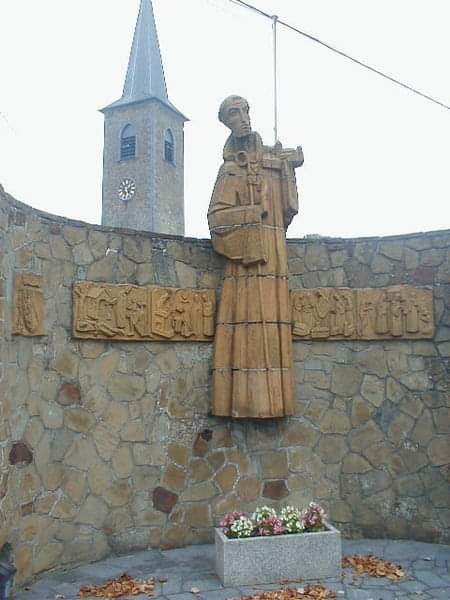
Monument of the Ewalds standing in Dortmund-Aplerbeck, Germany
Christian sources describe various miracles after the priests' deaths, including their martyred bodies being miraculously carried against the stream for the space of forty miles to the place in which the companions of the Ewalds were residing. As they floated along, says the Catholic Encyclopedia, "a heavenly light, like a column of fire, was seen to shine above them." Even the murderers are said to have witnessed the miraculous brightness. Moreover, one of the martyrs appeared in vision to the monk Tilmon (a companion of the Ewalds), and told him where the bodies would be found: "that the spot would be there where he should see a pillar of light reaching from earth to heaven". Tilmon arose and found the bodies, and interred them with the honours due to martyrs. From that time onwards, the memory of the Ewalds was annually celebrated in those parts. A spring of water is said to have gushed forth in the place of the martyrdom.[2]
Pepin, Duke of Austrasia, having heard of the wonders that had occurred, caused the bodies to be buried in Cologne, where they were solemnly enshrined in the collegiate church of St. Kunibert. The heads of the martyrs were bestowed on Frederick, Bishop of Münster, by Archbishop Anno of Cologne, at the opening of the shrine in 1074. These relics were probably destroyed by the Anabaptists in 1534. When Saint Norbert visited Cologne, in 1121, he obtained two small vessels containing the relics of several saints, and among them were bones of the sainted Ewalds. These were deposited either at Prémontré or at Floreffe, a Premonstratensian monastery in the province of Namur. The two Ewalds are honoured as patrons in Westphalia, and are mentioned in the Roman Martyrology on 3 October. Their feast is celebrated in the dioceses of Cologne and Münster.[2] The Saxons were eventually converted to Christianity by force in the 8th century by Charlemagne.
Until the martyrdom of Saint Boniface in 754, the Ewalds were the last missionaries to be martyred in this area. Their deaths were undoubtedly due to a lack of support from the worldly rulers: "Ohne den fränkischen Schutz lebte ein Missionär nicht lange genug, um seine Lehre genauer zu erläutern," ("Without the Franconian protection, a missionary did not live long enough to explain his teaching more closely") according to Franz Staab.[1]
Druten, in the east of the Netherlands, has a church dedicated to the Ewalds, with statues for the two made in the studio Atelier Cuypers-Stoltzenberg, owned by Pierre Cuypers and F. Stoltzenberg.[3]
St. Hesychius
Feastday: October 3
Death: 380
Hermit and disciple of St. Hilarion. Hesychius was St. Hilarion's follower at Majuma, near Gaza, Israel. He followed St. Hilarion to Egypt and Sicily. Sent to Gaza by Hilarion, Hesychius heard of the saint's death on Cyprus. He sailed to Cyprus and brought Hilarion's remains to Majuma.
St. Maximian
Feastday: October 3
Death: 404
Bishop of Bagae, Numidia, modern North Africa. He was appointed as bishop in the midst of the severe Donatist heresy which troubled Africa. Maximian resigned his see because the local Christians rebelled and won approval of his resignation by the Council of Milevis owing to the determined hostility of the heretics. This was insufficient for the heretics, who hurled him from a tower. Maximian managed to recover from this assault and went to Italy, where Emperor Honorius approved his labors.
St. Menna
Feastday: October 3
Death: 395
Virgin of Lorraine, France, sometimes called Manna. She was related to Sts. Eucherius and Elaptius. Details of her life are not trustworthy.
St. Widradus
Feastday: October 3
Death: 747
Benedictine abbot of Flavigny, France, also called Ware, who was responsible for reviving the monastery and for establishing the community of Saulieu, near Autun.



St. Leger
Feastday: October 2
Birth: 615
Death: 679

Image of St. Leger
Leger was raised at the court of King Clotaire II and by his uncle, Bishop Didon of Poitiers. Leger was made archdeacon by Didon, was ordained, and in about 651, became abbot of Maxentius Abbey, where he introduced the Rule of St. Benedict. He served Queen Regent St. Bathildis and helped her govern when Clovis II died in 656, and was named bishop of Autun in 663. He reconciled the differing factions that had torn the See apart, introduced reforms, fortified the town, and was known for his concern for the poor. On the death of Clotaire III, he supported young Childeric II for King against his brother Thierry, who had been backed by Ebroin, mayor of the palace. Ebroin was exiled to Luxeuil and became a bitter enemy of Leger, who became Childeric's adviser. When Leger denounced the marriage of Childeric to his uncle's daughter, he also incurred the enmity of Childeric, and in 675 Leger was arrested at Autun and banished to Luxeuil. When Childeric was murdered in 675, his successor, Theodoric III, restored Leger to his See. Ebroin was also restored as mayor of the palace after he had had the incumbent Leudesius murdered and pursuaded the Duke of Champagne and the bishops of Chalons and Valence to attack Autun. To save the town, Leger surrendered. Ebroin had him blinded, his lips cut off, and his tongue pulled out. Not satisfied, several years, he convinced the King that Childeric had been murdered by Leger and his brother Gerinus. Gerinus was stoned to death, and Leger was tortured and imprisoned at Fecamp Monastery in Normandy. After two years Leger was summoned to a court at Marly by Ebroin, deposed, and executed at Sarcing, Artois, protesting his innocence to the end. Though the Roman Martyrology calls him Blessed and a martyr, there is doubt among many scholars that he is entitled to those honors. His feast day is October 2.
Leodegar of Poitiers (Latin: Leodegarius; French: Léger; c. 615 – October 2, 679 AD) was a martyred Burgundian Bishop of Autun. He was the son of Saint Sigrada and the brother of Saint Warinus.
Leodegar was an opponent of Ebroin, the Frankish Mayor of the Palace of Neustria and the leader of the faction of Austrasian nobles in the struggle for hegemony over the waning Merovingian dynasty. His torture and death made him a martyr and saint.[1]
Early life
Leodegar was the son of a high-ranking Burgundian nobleman, Bodilon, Count of Poitiers and Paris and Sigrada of Alsace, who later became a nun at Sainte-Marie de Soissons. His brother was Warinus.[1]
He spent his childhood in Paris at the court of Clotaire II, King of the Franks and was educated at the palace school. When he was older he was sent to Poitiers, where there was a long-established cathedral school, to study under his maternal uncle, Desiderius (Dido), Bishop of Poitiers. At the age of 20 his uncle made him an archdeacon.[1]
Shortly afterwards he became a priest, and in 650, with the bishop's permission, became a monk at the monastery of St Maxentius in Poitou.[2] He was soon elected abbot, and initiated reforms including the introduction of the Benedictine rule.[1]
Career
Around 656, about the time of the usurpation of Grimoald in Austrasia and the banishment of the boy-heir Dagobert II, Leodegar was called to the Neustrian court by the widowed Queen Bathilde to assist in the government of the united kingdoms and in the education of her children. Then in 659 he was named to the see of Autun, in Burgundy. He again undertook the work of reform and held a council at Autun in 661. The council denounced Manichaeism and was the first to adopt the Trinitarian Athanasian Creed. He made reforms among the secular clergy and in the religious communities, and had three baptisteries erected in the city. The church of Saint-Nazaire was enlarged and embellished, and a refuge established for the indigent. Leodegar also caused the public buildings to be repaired and the old Roman walls of Autun to be restored.[3] His authority at Autun placed him as a leader among the Franco-Burgundian nobles.
Meanwhile, in 660 the Austrasian nobles demanded a king, and young prince Childeric II was sent to them through the influence of Ebroin, the mayor of the palace in Neustria. The queen withdrew, from a court that was Ebroin's in all but name, to an abbey she had founded at Chelles, near Paris. On the death of King Clotaire III in 673, a dynastic struggle ensued, with rival claimants as pawns; Ebroin raised Theoderic to the throne, but Leodegar and the other bishops supported the claims of his elder brother Childeric II, who, by the help of the Austrasians and Burgundians, was eventually made king. Ebroin was interned at Luxeuil and Theoderic sent to St. Denis.[3]
Leodegar remained at court, guiding the young king. In 673 or 675, however, Leodegar was also sent to Luxeuil. The cause, a protest against the marriage of Childeric and his first cousin, is a hagiographic convention;[4] as a leader of the Austrasian and Burgundian nobles, Leodegar was easily represented as a danger by his enemies. When Childeric II was murdered at Bondi in 675, by a disaffected Frank, Theoderic III was installed as king in Neustria, making Leudesius his mayor. Ebroin took advantage of the chaos to make his escape from Luxeuil and hasten to the court. In a short time Ebroin caused Leudesius to be murdered and became mayor once again, still Leodegar's implacable enemy.[3]
The martyrdom of St. Leger
About 675 the Duke of Champagne, the Bishop of Châlons-sur-Marne and the Bishop of Valence, stirred up by Ebroin, attacked Autun, and Leodegar fell into their hands. At Ebroin's instigation, Leodegar's eyes were gouged out and the sockets cauterized, and his tongue was cut out. Some years later Ebroin persuaded the king that Childeric had been assassinated at the instigation of Leodegar. The bishop was seized again, and, after a mock trial, was degraded and condemned to further exile, at Fécamp, in Normandy. Near Sarcing he was led out into a forest on Ebroin's order and beheaded.[5]
A dubious[4] testament drawn up at the time of the council of Autun has been preserved as well as the Acts of the council. A letter which he caused to be sent to his mother after his mutilation is likewise extant.
In 782, his relics were translated from the site of his death, Sarcing in Artois, to the site of his earliest hagiography – the Abbey of St Maxentius (Saint-Maixent) near Poitiers. Later they were removed to Rennes and thence to Ebreuil, which place took the name of Saint-Léger in his honour. Some relics are still kept in the cathedral of Autun and the Grand Séminaire of Soissons. In 1458 Cardinal Rolin caused his feast day to be observed as a holy day of obligation.
For sources to his biography, there are two early (though not contemporaneous) Lives,[6] drawn from the same lost source (Krusch 1891), and also two later ones (one of them in verse).
Cultural significance
Historically there was a custom among wealthy British merchants to sell in May, spend the summer outside of London, then to return on St Leger's Day. This gave rise to the saying used in regards to financial trading markets, "Sell in May and go away, and come on back on St. Leger's Day".[7]
St. Beregisius
Feastday: October 2
Death: 725
Confessor of Pepin of Heristal and founder of the abbey of Saint-Hubert in the Ardennes region of France. There is some doubt as to whether he was a monk.
St. Eleutherius of Nicomedia
Feastday: October 2
Death: 303
A
A soldier in the army of coEmperor Diocletian in Nicomedia. He was accused of setting fire to the emperor's palace and was burned to death after being tortured with companions.
St. Eleutherius of Nicomedia (died 303) was a soldier who was martyred under Diocletian. He was accused of trying to burn the palace of Diocletian. His feast day is October 2.[1]
