St. Fiace
Feastday: October 12
Death: 5th century
An Irish bishop sometimes listed as Fiech. A disciple of St. Patrick, he wrote a hymn in St. Patrick's honor.

St. Fiace
Feastday: October 12
Death: 5th century
An Irish bishop sometimes listed as Fiech. A disciple of St. Patrick, he wrote a hymn in St. Patrick's honor.
St. Heribert of Cologne
Feastday: October 12
Patron: of Rain
Birth: 970
Death: 1021

Archbishop of Cologne, Germany, and chancellor of Emperor Otto III . He was born in Worms, where he was ordained after being educated by the Benedictines of Gorze in Lorraine, France. Serving Otto III, Heribert was made an archbishop on 998. Heribert accompanied Otto to Italy in 1002, and brought the emperor's body back to Aachen when Otto died. He also served Emperor St. Henry. Heribert built the monastery of Deutz, on the Rhine and performed miracles, including ending a drought. He is thus invoked for rains. He died in Cologne on March 16, and was buried at Deutz. Heribert was canonized by Pope St. Gregory VII about 1074. Feast day: March 16. Herlindis With Relindis, Benedictine abbesses, the daughters of Count Adelard, who built them a convent at Maaseik on the Meuse, Belgium. These saints were friends of Sts. Willibrord and Boniface.
Heribert of Cologne (c. 970 – 16 March 1021), also known as Saint Heribert, was a German Roman Catholic prelate who served as the Archbishop of Cologne from 999 until his death.[1] He also served as the Chancellor for the Emperor Otto III since 994. He also collaborated with Henry II, Holy Roman Emperor with whom relations were strained though were strengthened over time.[2]
Heribert's canonization was confirmed around 1075.[1]
Heribert was born around 970 in Worms to Count Hugo and Tietwista. On the maternal side his half-brother was Heinrich who was the Bishop of Würzburg and his brother was Earl Getseman Vingngau.[1]
He was educated in the school at the Worms Cathedral and at the Benedictine Gorze convent in Lorraine. Heribert studied alongside Bruno de Carinthia who was the future Pope Gregory V.[1] He wanted to become a Benedictine monk but his father disapproved of that path and Heribert no longer pursued it. He returned to the Worms Cathedral to serve as its provost and received his ordination to the priesthood in 994 from Bishop Holdebold. The Bishop of Worms wanted Heribert to be his successor though the emperor took notice of him and planned to bring him as an advisor to his court.[2]
The Emperor Otto III appointed him in 994 as the Italian chancellor and in 998 for the German kingdom. He held the latter position until Otto III's death. He had accompanied the emperor to Rome in 996 and again in 997 and was still on the peninsula when word came that he had been chosen as the Archbishop of Cologne. In Benevento he received investiture and the pallium from the new Pope Sylvester II on 9 July 999 and on the following Christmas received his episcopal consecration at Cologne in the archdiocesan cathedral.[1]
In 1002 he was present at the deathbed of Otto III at Paterno. While returning to his homeland to Aachen with the Emperor's remains and the imperial insignia he was captured at the behest of the future Saint Heinrich II whom he had first opposed but later served. Once the latter was made king in 1002 he acknowledged him as such and served as his collaborator and still as chancellor.[1] The pair's relations were not the best though the new emperor came to respect his abilities and the rift between them turned into a friendship.[2] In 1003 he founded the Deutz convent on the Rhine. Heribert often sent alms to the poor and sent alms to priests to distribute to the poor.
Heribert died on 16 March 1021 in his archdiocese and was buried at his convent church after their transferal on 30 August 1147.[1] Heribert contracted a fever while on a pastoral visitation and hurried back to Cologne to recover where he died within the week.[2]
Canonization
Heribert was honoured as a saint during his lifetime and was canonized in about 1075. His reported miracles included ending a drought; he is thus invoked for beneficial rains.
His relics were kept in the convent church at Deutz in a golden casket which is now preserved in the parish church of "Neu-St.Heribert" in Köln-Deutz.[3].
Bl. Maria Teresa Fasce
Feastday: October 12
Birth: 1881
Death: 1947
Beatified: 12 October 1997 by Pope John Paul II

Maria Terese of Cascia was born in Torriglia, a small town near Genoa, Italy in 1881 to a middle-class family. Her parents had her baptized with the name Maria, but throughout her life, she was called "Marietta."
Although Marietta lost her mother when she was eight, she was well looked after by her older sister. Religious values were taught at home and Marietta was enrolled in school where she did well. Marietta was lively and vivacious, and she responded well to instruction.
In Genoa, she attended the Augustinian parish of Our Lady of Consolation, a place where she would be greatly inspired to her life's vocation as a nun. Marietta met her confessor there, Father Mariono Ferriello, who encouraged her to pursue her vocation. Marietta was also taught catechism there along with signing. She also learned extensively about St. Augustine, whose spirituality greatly influenced her.
The singular event, which influenced Marietta the most, however, was the canonization of St. Rita of Cascia. Pope Leo XIII canonized St. Rita on May 24, 1900. Along with the canonization, there were lectures, liturgical celebrations, and other events celebrating the life of St. Rita. This influenced Marietta to live a religious life.
Marietta had been contemplating a religious lifestyle for some time, but the canonization of St. Rita compelled her to announce her intentions to her family, who took the news badly. Marietta's brothers were particularly negative about her decision. Still, Marietta was undeterred and she felt absolutely sure she wanted to enter the convent.
Marietta applied for admission to a Ligurian Augustinian monastery, but she was rejected, news which shocked and surprised her. The monastery's abbess, Mother Giuseppina Gattarelli, explained she felt that Marietta, accustomed to life in the city, would not be able to handle the spartan rigors of a rural monastery. Still, Marietta was tenacious; she reapplied and was accepted in 1906.
Thus, in 1906, Marietta began her religious career.
On Christmas night of 1906, Marietta was given her habit and one year later she took vows of chastity, poverty, and obedience. The name, "Teresa Eletta" was given to her.
Unfortunately for Marietta (now Maria Teresa Eletta) she discovered a monastery in crisis. A group of seven young sisters from Visso who were much more relaxed in their practice than the older sisters created a generational crisis. The levity and laughter did little to promote Maria's spiritual growth and disappointment and doubt began to develop in her mind. In June of 1910, Maria Theresa left the monastery to reexamine her decision.
However, Maria returned in May of 1911, more confirmed than ever. The following March, she made her solemn profession of the vows. She promptly protested the situation at the monastery by writing letters to the superiors. Impressed with her alacrity, she was soon appointed to Mistress of Novices in 1914. In 1917, she became Vicar, and in 1920 her sisters unanimously elected her Abbess. She would hold that position until her death in 1947.
Maria Teresa was remembered as a strict, but practical woman who was also very sweet to her community. She made clear to all that Jesus wants active, hard working brides, and that being such would be their duty. She rigidly observed the Augustinian Rule.
Despite her rigidity, her community remembered her for her great tenderness and friendliness. She was not considered a dictator, but a genuine spiritual leader with great charisma.
Maria Terese was also known for her great stamina. As abbess, she directed the construction of a new church for Saint Rita and a girl's orphanage. This project consumed much of her tenure, and in fact, the church was not completed until several months after her death.
Maria Terese also spent much of her time in illness, suffering from painful afflictions. She suffered with a malignant tumor on her right breast and was compelled to undergo two surgeries. She referred to her tumor as "her treasure" and explained that it was the most beautiful gift which Jesus had given to her. She also suffered from asthma, diabetes, and circulatory problems which caused great pain in her feet. She became very overweight and had difficulty walking. Later in her tenure, her sisters had to carry her in a chair.
Despite her pain, she never complained about her illness and she never slowed the pace of her activity. Her condition has been compared to the suffering of Christ, which like Jesus, she bore with patience and reverence.
Maria Terese died on January 18, 1947. She was laid to rest in a crypt next to her beloved St. Rita. Pope John Paul beautified her in July 1997.
Augustinians celebrate her feast day on October 12.
St. Maximilian of Lorch
Feastday: October 12
Death: 288

Martyred bishop of Lorch. He was born at Cilli, modem Steiermark, in Styria, Austria, and disposed of his wealth to make a pilgrimage to Rome. Pope Sixtus II sent him to Lorch, near Passau, where he served two decades as a missionary bishop. He was then beheaded by command of the Roman Prefect Numerian at the gate of Cilli for refusing to sacrifice to the gods.
For other saints of the same name, see Maximilian.
Depiction of Maximilian of Lorch on a vitrail of the parish church in Aigen, Upper Austria
Grave of Saint Maximilian in Celje, Slovenia
Saint Maximilian of Lorch (also: Maximilian of Celeia, Latin: Maximilianus) (died 12 October 288)[1] was a missionary in the Roman province of Noricum. He was martyred in AD 288.[2]
Maximilian was born in Celeia in the Roman province of Noricum (in present-day Slovenia). As an adult he made a pilgrimage to Rome.[2] Pope Sixtus II sent him to Lauriacum (Lorch) in the Roman province of Noricum, where he worked as a missionary during the latter half of the third century.[2] He founded the church of Lorch. Maximilian was beheaded by the Roman Prefect of Emperor Numerian after refusing to abandon Christianity and sacrifice to the pagan gods. He is remembered on 12 October (and in some locations on 29 October).[2]
His cult dates at least from the eighth century. In that century, Saint Rupert built a church in his honour at Bischofshofen in the Salzach valley, and brought his relics there. They were later transferred to Passau in 985.[2]
St. Monas
Feastday: October 12
Bishop of Milan from 193. He endured many Roman persecutions in his era.

Monas (Italian: Mona) was Bishop of Milan from the end 3rd-century to early 4th-century. He is honoured as a Saint in the Catholic Church and his feast day is on October 12.[1]
Life
Almost nothing is known about the life and the episcopate of Monas. He was elected as bishop of Milan in some year at the end of the 3rd-century (tentatively on 283), and his episcopate lasted till some year before the 313, when surely the bishop of Milan was already Mirocles.[2]
Monas died on the 25 March (the year had not been recorded) and his corpse was buried near the church of Saint Vitalis of Milan (Basilica Fausta), that was placed in the area where now stand the Basilica of Sant'Ambrogio. Under the episcopate of Arnulf II (998-1018), on a 12 October, his relic were discovered and translated into the church of Saint Vitale near the Basilica Naboriana (now demolished). On 6 February 1576 his relics were translated by Saint Charles Borromeo to the Cathedral of Milan where are today.[3]
A late tradition, with no historical basis, associates Monas with the Milan's noble family of the Borri. To Monas is attributed the foundation of the parish church of Corbetta. Monas is also venerated in a chapel, renovated in the 17th century by the Borri family, in the Santuario della Beata Vergine dei Miracoli of Corbetta.[4]
St. Pantalus
Feastday: October 12
Death: unknown

Image of St. Pantalus
Bishop and martyr of Basel, Switzerland. He is linked to the traditions concerning St. Ursula.
St. Salvinus
Feastday: October 12
Death: 562
Bishop of Verona, Italy, whose relics are enshrined in that city’s church of St. Stephen. He is believed to have been the successor of St. Valens there.


St. John XXIII
Feastday: October 11
Patron: of Papal delegates, Patriarchy of Venice, Second Vatican Council
Birth: 1881
Death: 1963
Beatified: 3 September 2000 by Pope John Paul II

Image of St. John XXIII
The man who would be Pope John XXIII was born in the small village of Sotto il Monte in Italy, on November 25, 1881. He was the fourth of fourteen children born to poor parents who made their living by sharecropping. Named Angelo Giuseppe Roncalli, the baby would eventually become one of the most influential popes in recent history, changing the Church forever.
Roncalli's career within the Church began in 1904 when he graduated from university with a doctorate in theology. He was ordained a priest thereafter and soon met Pope Pius X in Rome.
By the following year, 1905, Roncalli was appointed to act as secretary for his bishop, Giacomo Radini-Tedeschi. He continued working as the bishop's secretary until the bishop died in August 1914. The bishop's last words to Roncalli were, "Pray for peace."
Such words mattered in August 1914 as the world teetered on the brink of World War I. Italy was eventually drawn into the war and Roncalli was drafted into the Italian Army as a stretcher bearer and chaplain.
Roncalli did his duty and was eventually discharged from the army in 1919. Free to serve the Church in new capacities he was appointed to be the Italian president of the Society for the Propagation of the Faith, handpicked by Pope Benedict XV.
Then in February 1925, Roncalli was summoned to the Vatican and given a new mission. This time he was sent to Bulgaria as the Apostolic Visitor to that country. Later, he was appointed aspostolic delegate to Turkey and Greece and made archbishop of Mesembria.
Beginning in 1935, racial tensions and anti-Jewish sentiment began to explode into actual acts of violence against the Jews and other ethnic minorities. Roncalli started using his influence to save what people he could from the depredation of both local authorities and later the Nazis. During his tenure as archbishop, Roncalli saved thousands of Jews, enough that he was named a "Righteous Gentile" following the war.
In late 1944, the Church was anxious to remove clergy in France that had collaborated with the Nazis in various forms. Roncalli was appointed as the new papal Nuncio and sent to France to negotiate the retirement of bishops who were involved with the Nazis.
In 1952, Roncalli was offered a new position, this time as Patriarch of Venice. At the same time he assumed his new title, Roncalli became the Cardinal-Priest of Santa Prisca. He assumed his new responsibilities on March 15, 1953.
Roncalli's papal predecessor died on October 9, 1958 and he was soon summoned to Rome where he was to participate in the process of selecting a new pope. The College eventually settled on Roncalli for election and he accepted, saying "I will be called John," a surprising choice because of that name's association with schism.
15% OFF Sterling Silver Sale
As Pope John XXIII, he immediately began to change the culture in the Vatican. On Christmas, 1958, he resumed the papal practice of making visits to the community within the official Diocese of Rome. He visited the sick, the poor, and prisoners. He apologized for episodes of anti-Semitism within the Church carried on by some of his predecessors.
It was originally expected that Pope John XXIII would only serve a short time before passing away and that he would make no significant changes to Church practice. However, Pope John XXIII was a man of great mercy and kindness and much like Pope Francis of today, he did many things that created sensation in the streets and pews.
Perhaps his most influential decision was the call for an ecumenical council which would be known as Vatican II. As a result of this council, many practices of the classic Church would be altered with a new emphasis on ecumenism and a new liturgy.
Pope John XXIII addressed several topic of importance to Catholics around the world. He prohibited the use of contraceptives which interfere with the procreative will of God. He upheld the traditional view that married couples may not divorce. He also moved to protect the Church from scandal, ordering confidentiality when dealing with matters of clergy accused of the sexual abuse of children. How his request to the bishops of his time was interpreted remains subject to debate.
By late 1962, Pope John XXIII has executed most of the work for which he would be known. He was, like his own sister before him, diagnosed with stomach cancer, which was a terminal diagnosis for that time.
In his last months, he offered to negotiate peace between the Soviet Union and the United States, then at the height of the Cold War. The offer, although declined, was popular in both countries. In the wake of the news, John XXIII was the first pope to be honored as the Time Magazine Man of the Year.
Pope John XXIII did the best he could although his health and doctors were failing. On June 3, 1963, Pope John XXIII died in his bed at age 81.
The world mourned John XXIII and he was posthumously awarded the Presidential Medal of Freedom by President Johnson in December 1963.
Pope John XXIII generally maintained a good reputation among those who remembered him and he was often titled "the Good."
On September 3, 2000, Pope John Paul beatified him. Miracles were attributed to him and his body was found to be in an uncorrupted state, a phenomenon consistent with sainthood. His body was put on display for the veneration of the faithful.
Free Online Catholic Classes for Anyone, Anywhere - Click Here
Pope Francis approved John XXIII for canonization on June 3, 2013, the 50th anniversary of his death.
Bl. Pope John XXIII will be canonized on April 27, 2014 alongside Bl. Pope John Paul II in a historic ceremony to be presided by Pope Emeritus Benedict and Pope Francis. It will be a historic ceremony with two living men with the title of pontiff presiding together.
Pope John XXIII's feast day will be October 11, as opposed to the day of his death, which is June 3. This special feast day is intended as a commemoration of the opening of the Second Vatican Council on October 11, 1962.
For the 15th-century Pisan antipope, see Antipope John XXIII.
Pope John XXIII (Latin: Ioannes; Italian: Giovanni; born Angelo Giuseppe Roncalli, Italian pronunciation: [ˈandʒelo dʒuˈzɛppe roŋˈkalli]; 25 November 1881 – 3 June 1963) was head of the Catholic Church and sovereign of the Vatican City State from 28 October 1958 to his death in 1963. Angelo Giuseppe Roncalli was one of thirteen children born to a family of sharecroppers who lived in a village in Lombardy.[6] He was ordained to the priesthood on 10 August 1904 and served in a number of posts, as nuncio in France and a delegate to Bulgaria, Greece and Turkey. In a consistory on 12 January 1953 Pope Pius XII made Roncalli a cardinal as the Cardinal-Priest of Santa Prisca in addition to naming him as the Patriarch of Venice. Roncalli was unexpectedly elected pope on 28 October 1958 at age 76 after 11 ballots. Pope John XXIII surprised those who expected him to be a caretaker pope by calling the historic Second Vatican Council (1962–1965), the first session opening on 11 October 1962.
John XXIII made many passionate speeches during his pontificate. His views on equality were summed up in his statement, "We were all made in God's image, and thus, we are all Godly alike."[7][8] He made a major impact on the Catholic Church, opening it up to dramatic unexpected changes promulgated at the Vatican Council and by his own dealings with other churches and nations. In Italian politics, he prohibited bishops from interfering with local elections, and he helped the Christian Democratic Party to cooperate with the socialists. In international affairs, his "Ostpolitik" engaged in dialogue with the Communist countries of Eastern Europe. He especially reached out to the Eastern Orthodox churches. His overall goal was to modernize the Church by emphasizing its pastoral role, and its necessary involvement with affairs of state. He dropped the traditional rule of 70 cardinals, increasing the size to 85. He used the opportunity to name the first cardinals from Africa, Japan, and the Philippines. He promoted ecumenical movements in cooperation with other Christian faiths. In doctrinal matters, he was a traditionalist, but he ended the practice of automatically formulating social and political policies on the basis of old theological propositions.[9]
He did not live to see the Vatican Council to completion. His cause for canonization was opened on 18 November 1965 by his successor, Pope Paul VI, who declared him a Servant of God. On 5 July 2013, Pope Francis – bypassing the traditionally required second miracle – declared John XXIII a saint, based on his virtuous, model lifestyle, and because of the good which had come from his having opened the Second Vatican Council. He was canonised alongside Pope John Paul II on 27 April 2014.[10][11] John XXIII today is affectionately known as the "Good Pope" and in Italian, "il Papa buono".
† இன்றைய புனிதர் †
(அக்டோபர் 11)
✠ புனிதர் இருபத்திமூன்றாம் யோவான் ✠
(St. John XXIII)
261ம் திருத்தந்தை:
(261st Pope)
பிறப்பு: நவம்பர் 25, 1881
சோட்டோ இல் மோன்ட்டே, பெர்கமோ, இத்தாலி அரசு
(Sotto il Monte, Bergamo, Kingdom of Italy)
இறப்பு: ஜூன் 3, 1963 (வயது 81)
அப்போஸ்தல மாளிகை, வத்திக்கான் நகரம்
(Apostolic Palace, Vatican City)
ஏற்கும் சமயம்:
ரோமன் கத்தோலிக்க திருச்சபை
(Roman Catholic Church)
அமெரிக்காவில் இவாஞ்சலிக்கல் லூதரன் திருச்சபை
(Evangelical Lutheran Church in America)
கனடாவின் ஆங்கிலிக்கன் திருச்சபை
(Anglican Church of Canada)
அமெரிக்காவின் எபிஸ்கோபல் திருச்சபை
(Episcopal Church of the United States)
முக்திபேறு பட்டம்: செப்டம்பர் 3, 2000
திருத்தந்தை இரண்டாம் ஜான் பவுல்
(Pope John Paul II)
புனிதர் பட்டம்: ஏப்ரல் 27, 2014
திருத்தந்தை ஃபிரான்சிஸ்
(Pope Francis)
திருத்தந்தை புனிதர் இருபத்திமூன்றாம் யோவான் அல்லது இருபத்திமூன்றாம் அருளப்பர், கத்தோலிக்க திருச்சபையின் 261ம் திருத்தந்தையாக 1958-1963 காலகட்டத்தில் ஆட்சிசெய்தவர் ஆவார்.
“ஆஞ்செலோ ஜியுசெப் ரொன்கல்லி” (Angelo Giuseppe Roncalli) எனும் இயற்பெயர் கொண்ட இவர், 1881ம் ஆண்டு, நவம்பர் மாதம், 25ம் நாள் பிறந்தார். 1958ம் ஆண்டு, அக்டோபர் மாதம், 28ம் நாள் திருத்தந்தையாகத் தேர்ந்தெடுக்கப்பட்டு, சுமார் ஐந்து ஆண்டுகள் மட்டுமே ஆட்சி செய்தார். அக்குறுகிய ஆட்சிக்காலத்தில் இவர் 20ம் நூற்றாண்டுத் திருச்சபையில் நடந்த மிக முக்கிய நிகழ்வாகிய, 1962-1965 காலகட்டத்தில் நடந்த “இரண்டாம் வத்திக்கான் பொதுச்சங்கத்தை” (Second Vatican Council) கூட்டினார். ஆனால், வயிற்று புற்றுநோயால் பாதிக்கப்பட்டிருந்த திருத்தந்தை, அச்சங்கம் நிறைவுறுவதற்கு முன்னரே, 1963ம் ஆண்டு, ஜூன் மாதம், 3ம் நாள் மரித்தார்.
இளமைப் பருவம்:
“ஆஞ்செலோ ஜியுசெப் ரொன்கல்லி” (Angelo Giuseppe Roncalli), இத்தாலி நாட்டின் வடமேற்கு பிராந்தியமான “லொம்பார்டி’யின்” (Lombardy) “பெர்கமோ” (Bergamo) என்னும் பகுதியைச் சார்ந்த “சோட்டோ இல் மோன்ட்டே” (Sotto il Monte) என்னும் சிற்றூரில் பிறந்தார்.
அவருடைய தந்தை, “ஜியோவன்னி பட்டிஸ்டா ரொன்கல்லி” (Giovanni Battista Roncalli) ஆவார். தாயார் “மரியன்னா ஜியூலியா மஸ்சொல்லா” (Marianna Giulia Mazzolla) ஆவார். அவர்களுக்குப் பிறந்த பதின்மூன்று குழந்தைகளுள் ஆஞ்செலோ ஜியுசெப் ரொன்கல்லி நான்காமவர் ஆவார். 1889ம் ஆண்டு, தமது எட்டு வயதில் “புதுநன்மை” மற்றும் “உறுதிப்பூசுதல்” ஆகிய இரண்டு அருட்சாதனங்களை பெற்றார்.
சிறுவயதிலேயே குருவாகப் பணிபுரிய ஆர்வம் கொண்ட ஆஞ்செலோ ஜியுசெப் ரொன்கல்லி, தம் உறவினர் ஒருவர் அளித்த நிதி உதவியோடு பெர்கமோ சிறு குருமடத்தில் கல்வி பயின்றார். கல்வி உதவித்தொகை பெற்று, ரோமில் புனித அப்போல்லினார் குருமடத்தில் (இன்றைய "ரோம் திருத்தந்தை பெரிய குருமடம்") கல்வி கற்றார். 1896ம் ஆண்டு, மார்ச் மாதம், 1ம் தேதி, “ஃபிரான்சிஸ்கன் சபையில்” (Secular Franciscan Order) இணைந்தார். 1904ம் ஆண்டு இறையியலில் டாக்டரேட் பட்டம் பெற்ற இவர், ஆகஸ்ட் மாதம், 10ம் நாள் குருத்துவ அருட்பொழிவு பெற்றார்.
ரொன்கல்லி, சிறுவயதிலிருந்தே அன்னை மரியாள் மீது மிகுந்த பக்தி கொண்டிருந்தார். மிலன் மறை மாவட்டத்தைச் சேர்ந்த இம்பெர்சாகோ என்னும் ஊரில் அமைந்திருந்த அன்னை மரியாள் திருத்தலத்துக்கு அவர் பல முறை திருப்பயணமாகச் சென்றுவந்தார்.
திருச்சபையில் பணிபுரிதல்:
பெர்கமோ மறைமாவட்டத்தின் புதிய ஆயர் “ஜியாகோமோ” (Giacomo Radini-Tedeschi) தமது செயலராக ரொன்கல்லியை 1905ம் ஆண்டு நியமித்தார். அப்பணியை மிக்க விசுவாசத்தோடும் திறமையோடும் ஆற்றினார். 1914, ஆகஸ்ட் 22ம் நாள் ஆயரின் மரண நாள்வரை தமது ஆயரின் செயலராகப் பணிபுரிந்தார். அதே சமயம் பெர்கமோ குருமடத்தில் திருச்சபை வரலாறு கற்பித்தார்.
முதலாம் உலகப்போரின்போது (World War I), இத்தாலியின் அரச இராணுவத்தில் (Royal Italian Army) இவர் கட்டாய இராணுவ சேவை புரிந்தார். இராணுவத்தின் மருத்துவ பிரிவில், நோயாளிகளைத் தூக்கிச் செல்லும் “ஸ்ட்ரெச்சர்” தூக்குபவராகவும் (Stretcher-Bearer) சிட்றாலய குருவாகவும் (Chaplain) பணியாற்றிய இவர், 1919ம் ஆண்டின் தொடக்கத்தில் இராணுவத்திலிருந்து வெளியே வந்தார்.
1921ம் ஆண்டு, நவம்பர் மாதம், 6ம் தேதி ரோம் பயணித்த ரொன்கல்லி, திருத்தந்தை பதினைந்தாம் பெனடிக்ட்டை (Pope Benedict XV) சந்தித்தார். அவர் ரொன்கல்லியை இத்தாலியின் நற்செய்தி அறிவிப்புப் பணி தேசிய அமைப்பின் (Society for the Propagation of the Faith) தலைவராக நியமித்தார். ரொன்கல்லி, தாம் சந்தித்த திருத்தந்தையருள் திருத்தந்தை பதினைந்தாம் பெனடிக்ட் மிகவும் அனுதாபம் மிக்கவர் என்று நினைவுகூறுவார். ரொன்கல்லி, திருச்சபையின் பல்வேறு பொறுப்புமிக்க பதவிகளை வகித்தார்.
திருத்தந்தை இருபத்துமூன்றாம் யோவான் தமது பதவி காலத்தில், பல உணர்ச்சிபூர்வமான பிரசங்கங்கள் நிகழ்த்தினார். அவை மிகவும் பிரசித்தி பெற்றவையாகும். எடுத்துக்காட்டாக, இரண்டாம் வாட்டிகன் பொது சங்கத்தின் (Second Vatican Council) தொடக்க நாளின் நடுநிசியில், தூய பேதுரு சதுக்கத்தில் (St. Peter's Square) கூடியிருந்த கூட்டத்தில் உரையாற்றிய திருத்தந்தை கூறிய சில வார்த்தைகள்:
“என் அன்பார்ந்த குழந்தைகளே! நீங்கள் வீடு திரும்புகையில், உங்கள் குழந்தைகளை சந்திப்பீர்கள். அவர்களை அணைத்தவாறு, இது திருத்தந்தையின் சார்பில் என்று கூறுங்கள்” (Dear children, returning home, you will find children; give your children a hug and say: This is a hug from the Pope!)
St. Agilbert
Feastday: October 11
Death: 673

Agilbert was a Frank (bishop) who had studied under abbot Ado at Jouarre monastery in Ireland . He was invited by King Coenwalh of the West Saxons to remain in Wessex as bishop. He was active in missionary activities, ordained St. Wilfrid, and with him was a leader among those seeking to replace the Celtic customs with Roman at the synod of Whitby. He resigned his See when Coenwalh divided his diocese. He returned to France, where he became bishop of Paris in 668. Coenwalh later invited him back but he refused and sent his nephew Eleutherius in his place. feast
Agilbert (fl. c. 650–680) was the second bishop of the West Saxon kingdom and later bishop of Paris.
The date and place of Agilert's birth are unknown, but evidence suggests it took place between 610 and 620.[1][2] Son of a Neustrian noble named Betto, he was a first cousin of Audoin and related to the Faronids and Agilolfings,[3] and less certainly to the Merovingians.[4] His name, the Frankish language equivalent of Æthelberht, has been taken to suggest a link with the royal family of the Kingdom of Kent.[5]
Agilbert was consecrated as a bishop in Francia before he travelled to Britain. He arrived in the West Saxon kingdom after the return to power of King Cenwalh of Wessex, who had been driven out by Penda of Mercia, either in the late 640s or 650s. He was appointed to succeed Birinus (also later canonised, and attributed with conversion of Wessex to Christianity) as bishop of the West Saxons, or the Wessex folk, who following their seizure of part of Christian Mercia set up the first Wessex see as Bishop of Dorchester, near Oxford. Nothing remains above the surface of the Saxon cathedral, succeeded in the faith by Norman Dorchester Abbey church which has decorative memorials to the two early bishops. Agilbert, according to Bede's Historia ecclesiastica gentis Anglorum, had "spent a long time in Ireland for the purpose of studying the Scriptures".[6] His appointment was due to Cenwalh.[7]
From Bede, it appears that Agilbert did not speak Old English, and it is said that his see was divided in two, with Wine being given half, because King Cenwalh "tired of his barbarous speech",[6] although this may be mistaken.[8] This insult supposedly led to Agilbert's resignation. He then travelled north to Northumbria, where he ordained Wilfrid.[9] He was present at the Synod of Whitby in 664, where he led the pro-Roman party, but he had the young Wilfrid speak on his behalf.[10]
The charter of Clotilde, 10 March 673, endowing the monastery of Bruyères-le-Châtel; witnessed by Agilbert, this is his last appearance in year-dated records
Returning to Francia, Agilbert later took part in Wilfrid's consecration as a bishop at Compiègne.[11] Agilbert became bishop of Paris between 666 and 668, and hosted Theodore of Tarsus. He was later invited to return by Cenwalh, to become bishop of Winchester, but sent his nephew Leuthhere in his place.[12]
One modern historian, D. P. Kirby, is unsure if Agilbert actually went to Northumbria after being expelled from Dorchester, suggesting it is just as likely that he went directly to the continent.[7]
Agilbert died at some time after 10 March 673, on which date he witnessed Clotilde's foundation charter for the Abbey of Bruyères-le-Châtel, and probably between 679 and 690. He was buried at Jouarre Abbey where his sister Theodechildis was abbess. His fine sculpted sarcophagus can be seen there in the crypts, as can that of his sister.[12]
St. Alexander Sauli
Feastday: October 11
Birth: 1535
Death: 1592
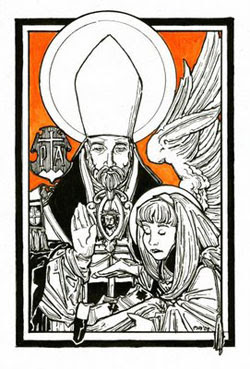
The Apostle of Corsica and bishop. He came from a prominent family of Lombard, Italy, born in Milan in 1533. At an early age he entered the Barnabite Congregation, and became a teacher at the University of Pavia and superior general of the congregation. In 1571 he was appointed by Pope Pius V to Aleria on Corsica. Taking three companions, Alexander rebuilt churches, founded seminaries and colleges, and stood off the pirate raids in the area. He became the bishop of Pavia after refusing other sees, serving only a year before his death. Alexander was a noted miracle worker. He was also spiritual advisor to St. Charles Borromeo and to Cardinal Sfondrato, who became Pope Gregory XIV. He was canonized in 1904 by Pope St. Pius X
St. Anastasius V
Feastday: October 11
Martyr with St. Placi Genesius, and others. Nothing is known about the martyrs except that Anastasius was a priest.
St. Ansillo
Feastday: October 11
Death: 7th century
A monk whose life is obscure. His relics are in the Benedictine abbey of Lagny, near Meaux, France.
St. Canice
Feastday: October 11

All we know about St. Canice is from unreliable legend, according to which he was born at Glengiven, Ireland. He became a monk under St. Cadoc at Llancarfan, Wales, and was ordained there. After a trip to Rome, he studied under St. Finnian at Clonard, Ireland, accompanied by Ss. Kieran, Columba, and Comgall to St. Mobhi at Glasnevin. He preached for a time in Ireland, and then went to Scotland. A close friend of Columba's whom he accompanied on a visit to King Brude of the Picts. He was a most successful missionary, building a monastery at Aghaboe, Ireland, and probably one at Kilkenny. He is known as Kenneth and Cainnech. His feast day is October 11th.
"Canice" and "Saint Canice" redirect here. For other uses, see Canice (disambiguation) and Saint Canice (disambiguation).
Saint Cainnech of Aghaboe (515/16–600), also known as Saint Canice in Ireland, Saint Kenneth in Scotland, Saint Kenny and in Latin Saint Canicus, was an Irish abbot, monastic founder, priest and missionary during the early medieval period. Cainnech is one of the Twelve Apostles of Ireland[1] and preached Christianity across Ireland and to the Picts in Scotland.[2] He wrote a commentary on the Gospels, which for centuries was known as the Glas-Choinnigh or Kenneth's Lock or the Chain of Cainnech.[3]
Most of what is written about Cainnech's life is based on tradition, however he was considered a man of virtue, great eloquence and learning. His feast day is commemorated on 11 October in the Roman Catholic Church and the Eastern Orthodox Church according to their respective calendars (Gregorian or Church Julian) with additional feast days on 1st or 14 August in the Eastern Orthodox Church.
Introduction
A lot of what is known of Cainnech comes from legend. However, he is documented by Saint Adomnán (also known as Eunan), the ninth abbot of Iona who died in 704. Adomnán was a hagiographer and his greatest work Vita Columbae or Life of St. Columba contains references to Cainnech.[4][5]
Cainnech's background
Statue at St. Canice's Catholic Church, Kilkenny
Cainnech was born in 515 or 516, at Glengiven, near Dungiven in Ulster, the northern province in Ireland.[5] His full name was Cainnech moccu Dalánn.[6]
Cainnech's father Lughadh Leithdhearg was descended from the CorcoDalann or Ui Dalainn, a tribe whose ancestor, Dalann, is traced back to Fergus (King of Ulster), son of Ross, son of Rudhraighe. The Corco-Dalann were from an island referred to as "Insula Nuligi", and is usually identified with Inis-Doimhle or Inis-Uladh, which is now the Little Island, in the River Suir, south-east of Waterford.[3]
Lughadh was a distinguished bard, a highly trained, professional itinerant poet. Lughadh settled at Glengiven, in what is now County Londonderry. Lughadh ended up under the favour and protection of the chief of Cianachta, and became the tutor of the chieftain's son, Geal Breagach.[7]
Cainnech's mother was called Maul or Mella.[8] She attained an eminent degree of sanctity. The church of Thompleamoul or Capella Sanctae Maulae seu Mellae, beside Kilkenny city, was dedicated to God under her invocation.
Early life
St. Finnian imparting his blessing to the Twelve Apostles of Ireland
In early Christian Ireland the druid tradition collapsed, with the spread of the new faith. The study of Latin and Christian theology flourished in monasteries.
Cainnech spent his early years watching his chieftain's flocks. In 543 Cainnech became a pupil at Finnian's monastic school at Clonard. During the sixth century, some of the most significant names in the history of Irish Christianity studied at the Clonard monastery.[1] Twelve students who studied under St. Finian became known as the Twelve Apostles of Ireland, Cainnech was one of these. It was at Clonard that Cainnech became a friend and companion of St Colmcille (Columba).
In 544 he studied under St. Mobhi at the school of Glasnevin, with Kieran of Clonmacnoise and St. Comgall of Bangor. When plague scattered that community, he went to Saint Cadoc's monastery of Llancarfan in Glamorganshire in Wales, where he was ordained a priest in 545.[9]
He left for Rome to obtain the blessing of the reigning pontiff. In 550 he had returned to Glengiven, where he converted his foster-brother, Geal-Breagach, who afterwards assisted him in founding Drumachose, in nearby Limavady.
Scotland
In 565 Cainnech joined Columba in Scotland, where he is known as St. Kenneth. Adamnan tells of the arrival of Cainnech, on Iona. St. Columba had a prophecy of a "certain holy and excellent man, who will arrive here among us before evening." According to Adamnan, God provided Cainnech with a safe and calm crossing, even though the sea was perilous and stormy that day. St. Columba received him that evening with all honour and hospitality.[4]
Cainnech built a church in the place now known as Saint Andrews.[10] He built monastic cells on the island of Ibdon, possibly South Uist,[11] and Eninis, an oratory called Lagan-Kenny on the shores of Loch Laggan (the remains of which are marked on the OS map), and a monastery in Fife on the banks of the Eden. The saint may have been an important saint in converting South Uist to Christianity.[12] Cainnech's name is still recalled in the ruins of an ancient church, Kil-Chainnech on Tiree, in a burial ground, Kil-Chainnech, in Iona and Inch Kenneth off Mull.[13]
Return to Ireland
Cainnech spent a good deal of his time in County Meath and Ossory in what is now County Laois. In Ossory he had a good repute with the king, Colmann son of Feradach. Colman gave him grants of land including Aghaboe ("the field of the Ox") which became his principal monastery.[5] Aghaboe grew in importance, and in the 7th century sent St. Feargal as a missionary to the church of Salzburg, Austria. Aghaboe was for a time the site of the bishop's see until under Norman influence in the twelfth century the see transferred from Aghaboe to Kilkenny.[9] In 1346 Diarmaid Mac Giollaphádraig burned the town of Aghaboe, and completely destroyed Cainnech's shrine along with his relics.[3]
St. Canice's Cathedral in Kilkenny.
Kilkenny (Irish: Cill Chainnigh "The Church of Cainnech") was originally the name of a church erected by or dedicated to Cainnech, but was afterwards extended to the townland and parish.[14] Kilkenny was one of the last parts of Ireland to be converted to Christianity. Tradition asserts that in 597, Cainnech led a Christian force to Kilkenny to eliminate the last bastion of Druidic rule in Ireland. The last Archdruid of Ireland had retired with his Council to a mound in Kilkenny for safety. Cainnech led an army there and overcame them. He founded a monastery near what is now the Church of Ireland's St. Canice's Cathedral.[9] He died and was interred at Abbey of Aghaboe in 599/600.
Chain of Cainnech
In his old age Cainnech retired to an island in what was once Loch Cree, and wrote a commentary on all four Gospels. This became known as Glass Kinnich (Glas-Chainnigh) or the Chain of Cainnech.[5] This was long preserved in his church and became a continuous commentary in the Middle Ages.
Patronage
Cainnech is the patron of Aghaboe and together with St. Ciarán of Saigir, is one of the patrons of Kilkenny and the historic kingdom of Osraige.[8] St. Cainnech is also the patron saint of the shipwrecked.[13]
